


Cassy Versteeg – Optometrist
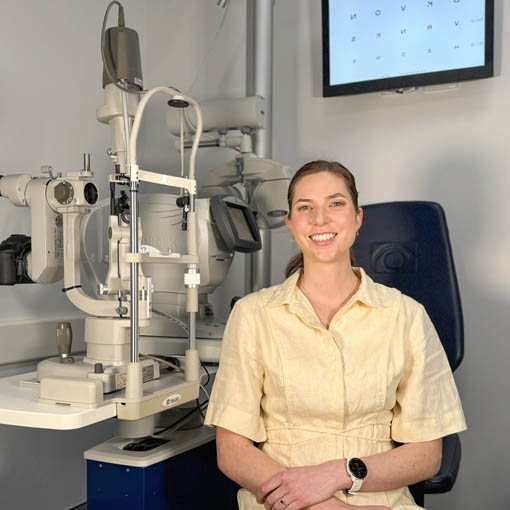
How did you decide what subjects to study in Years 11 and 12?
I hadn't decided what career path I would take, but knew I wanted to go to university. With that in mind, I picked subjects I was interested in and thought would likely apply to my potential future careers.
What inspired you to pursue your career, and what did that journey involve?
In Year 12 I had a pretty good idea I wanted to work in healthcare. My mum suggested I do a career personality test, and it recommended optometry. This was the first career that got me excited and made sense to me.
At the time, optometry required an OP1 (equivalent to an ATAR in the very high 90s), and I was not quite on track to achieve that. After discussing my options with advisors at school and university, I took a "bridging course" and studied one year of medical laboratory science, which shares a lot of first-year subjects with optometry. Through that, I achieved high enough grades to be accepted into optometry, and I was able to get credit for those subjects when I changed degrees.
What does a typical day at work look like?
Each day can be different! Some days I am consulting with my own patients or seeing them right after they have had eye surgery. Other days I am performing workups for patients that are seeing the ophthalmologists I work with, or helping determine patient suitability for refractive eye surgeries.
I also perform various tests on patients including checking their vision and assessing their glasses prescription and ocular health. Part of managing eye conditions and diseases involves creating management plans and prescribing medications for patients, so that can also be part of a typical workday.
What's your favourite thing about your job?
I love the patients and the impact I can make by helping manage their ocular health. Whether that's by improving dry eye symptoms, determining appropriate surgical interventions, or treating an eye disease or infection, it's rewarding to play a part in that journey.
Ocular health and vision are often overlooked until an issue comes up, so it's nice being able to educate people on their importance and help patients.
I also like that being an optometrist has given me a chance to work in regional Queensland, as well as in Brisbane. Working in different places has been a great experience.
How do you maintain a healthy work-life balance?
I prioritise downtime outside of work. For me, that means exercise, creative hobbies and socialising. I also stay aware of my workload and regularly monitor if it's sustainable. When I notice there's a lot going on, I speak with my colleagues to help determine strategies to make things more manageable. This has definitely been a learning curve!
What advice do you have for senior students?
You don't need to have it all worked out right now. Your decisions can evolve and change with you, and everything that you do will help lead you to the right place. If it feels too overwhelming to think about what you will do for the rest of your working career, try instead thinking about what you could see yourself doing and enjoying for the next two years and go from there.